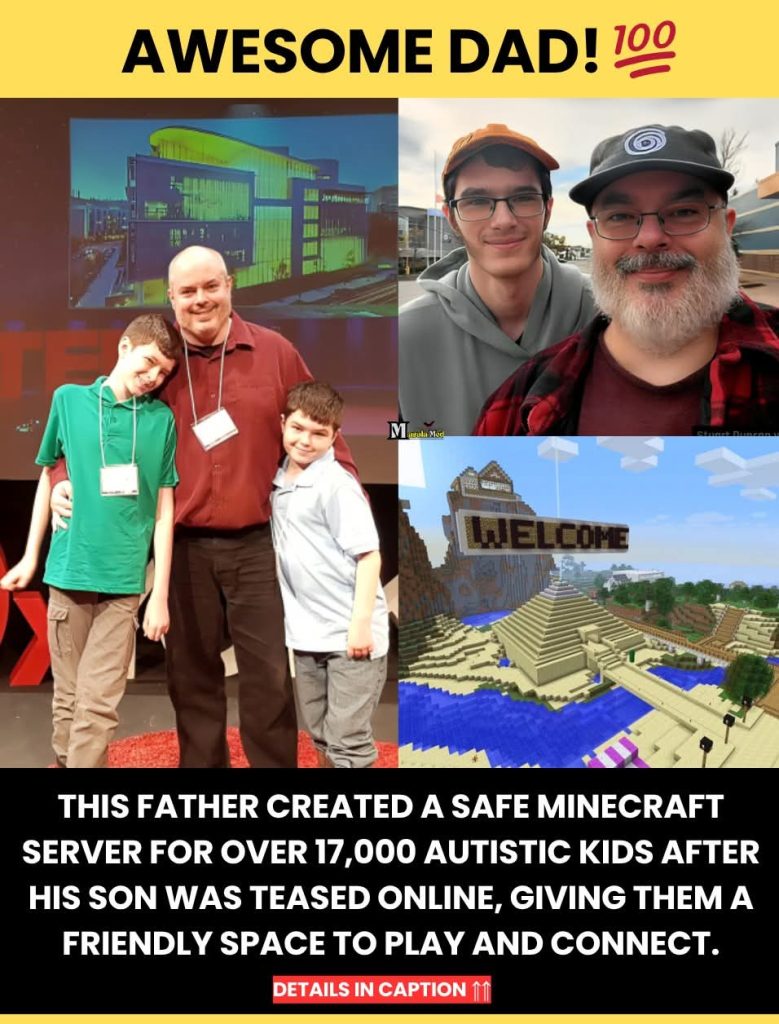
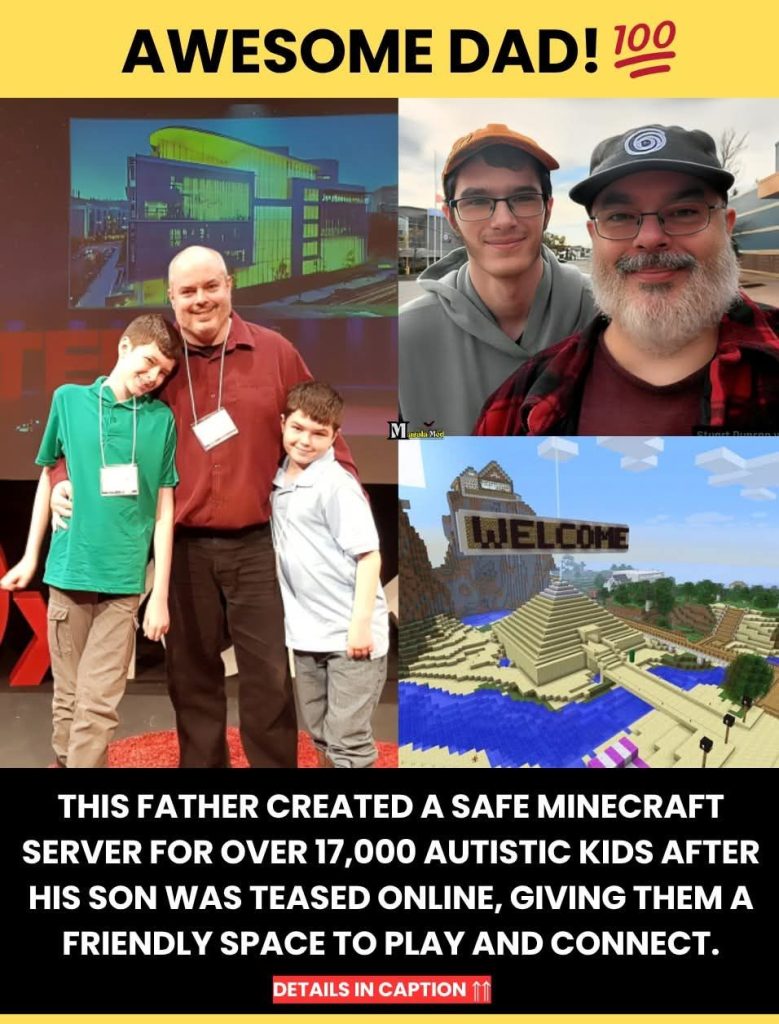
Stuart Duncan created Autcraft — a safe Minecraft world for autistic kids, turning gaming into a global movement of kindness and inclusion.
When most parents think of video games, they imagine screen time, distractions, or digital chaos. But for one father, Minecraft became much more than a game — it became a lifeline of connection, confidence, and kindness for children on the autism spectrum.
In an age where online spaces can often be toxic or isolating, this dad created something extraordinary: a Minecraft server designed specifically for autistic kids — a digital sanctuary where empathy and understanding rule instead of competition and judgment.
This is the story of how one man’s small idea turned into a global movement of inclusion, showing how technology can become a bridge, not a barrier, for those who see and experience the world differently.
The Beginning: A Father’s Motivation
It all started with one child.
The father, a software developer from the United States (who prefers to stay semi-anonymous online), noticed how his autistic son struggled to connect with other kids. School was overwhelming, social interactions often felt confusing, and playgrounds could quickly turn stressful.
But when his son discovered Minecraft, something magical happened.
Inside the pixelated universe of blocks, he wasn’t “different” anymore. He could create, explore, and communicate in his own rhythm. Building houses, exploring forests, and collaborating with others through text chat made him feel safe and confident — in control of his own world.
That’s when the idea struck:
“If my son feels this happy here, maybe other kids like him will too.”
The Birth of an Inclusive Minecraft World
In 2016, this dad launched a private Minecraft server initially for his son and a few friends. But what began as a small project soon blossomed into a global community.
Word spread among parents of autistic children. Families from across the world — the U.S., U.K., India, Canada, and Australia — began reaching out, asking if their kids could join.
Soon, dozens of children were playing together daily, helping each other build castles, sharing virtual gifts, and chatting about their favorite animals or songs.
But this wasn’t just another gaming space — it had rules rooted in kindness, patience, and inclusion.
Rules That Encourage Empathy
Unlike traditional online servers filled with competitive energy or bullying, this Minecraft world had a simple philosophy:
- No insults or teasing — only encouragement.
- Everyone builds at their own pace.
- No destroying others’ work (griefing).
- If someone is struggling, help — don’t judge.
- Celebrate effort, not perfection.
The father even coded a few unique in-game features:
- Positive message pop-ups, reminding players to take breaks and hydrate.
- Gentle moderation tools, where players could signal discomfort or anxiety.
- Color-coded chat options for better visual comfort.
This simple system transformed Minecraft from just a sandbox game into a therapeutic social environment.
The Impact: Stories from Around the World 🌍
Soon, hundreds of parents began sharing heartwarming stories.
A mother from London said her 9-year-old son, who rarely spoke in real life, started chatting confidently online — something she had never seen before.
A dad from Mumbai described how his daughter learned teamwork by building virtual farms with others — an activity that later helped her interact better at school.
One teacher from Australia reported that her students, who were part of the server, became more cooperative and expressive even outside the game.
These were not isolated events — they were signs that virtual play was reshaping real-world confidence.
External link: Read about Minecraft’s impact on autism communities (BBC)
Why Minecraft Works So Well for Autistic Players
Experts in psychology and education often highlight Minecraft’s unique structure as ideal for neurodivergent learners:
- Predictability: The environment follows consistent rules — nothing unexpected or chaotic.
- Creativity: Players can express themselves visually and constructively.
- Control: Players decide when to build, explore, or rest, minimizing anxiety triggers.
- Communication Flexibility: Players can choose between text, emotes, or silent play.
For autistic children, who often face challenges in unstructured or overstimulating social settings, this digital space becomes a comfort zone where their strengths shine.
Building Beyond Blocks: Emotional Growth
While Minecraft is often labeled as “just a game,” for these kids it’s a tool of emotional learning.
Through shared play, they develop empathy — helping another player repair a house or celebrate a new build becomes a form of positive social reinforcement.
The father noticed that children who joined the server regularly started using phrases like “good job!”, “thank you!”, or “I like what you built!”. These seemingly small expressions marked huge emotional progress.
He explains:
“In our world, kindness is currency. The more you give, the richer you become.”
Collaboration with Autism Experts
To ensure the community’s safety and developmental value, the father collaborated with autism therapists, educators, and psychologists. Together, they shaped guidelines on:
- Handling meltdowns or frustration in-game.
- Encouraging communication without pressure.
- Integrating visual schedules and rest zones.
They also designed “Quiet Zones” inside the server — serene areas with calming music, soft lighting, and minimal visual clutter where kids could go if they felt overstimulated.
Expansion: A Global Community of Kindness
By 2020, the server had grown into a network called AutCraft — the world’s first Minecraft server built exclusively for autistic kids and their families.
With thousands of members from more than 50 countries, it became a movement of digital inclusion, covered by international media outlets like the BBC, NPR, and The Guardian.
Even as the community expanded, the guiding principles stayed the same: empathy, respect, and joy.
Internal link: China Warns Mexico Over 50% Tariffs on Asian-Made Cars — a global reminder that kindness, not conflict, should shape our world, both online and offline.
Parents’ Perspective
Parents often describe the server as “life-changing.”
For many, this was the first time their children had friends — not through forced playdates or awkward introductions, but through shared creativity.
One mother said:
“When I see my son laughing and building with others online, I see him happy — not anxious, not scared. For me, that’s everything.”
The emotional relief for parents is immense. Knowing their children are safe from bullying and judgment while learning valuable social skills is priceless.
The Future of Inclusive Gaming
The father’s project has inspired a wave of similar initiatives worldwide. Game developers and educators are exploring ways to make virtual spaces more accessible for neurodiverse players.
Companies like Microsoft and Mojang have even consulted autism advocates to integrate better accessibility tools within the official game.
External link: Mojang’s Accessibility Features for Neurodiverse Players
These small steps represent a shift in how we view gaming — from entertainment to empowerment.
Life Lessons from a Pixelated World
Beyond the technology, the story reminds us of something timeless: empathy changes everything.
In a world often obsessed with competition, likes, and views, this father chose collaboration, patience, and care. His world became proof that love can be coded, and kindness can go viral — not as a trend, but as a way of life.
The Minecraft world he built doesn’t just teach kids how to play — it teaches them how to be human.
Conclusion
In an era where digital platforms are often criticized for toxicity and isolation, this father’s Minecraft server stands as a beacon of hope. It proves that the internet can be a place of healing, learning, and joy — if we choose to build it that way.
As his son now helps moderate the server — guiding new players and encouraging others — the journey comes full circle.
From one dad’s desire to help his child to a global network of kindness, this story shows us that compassion can be coded into even the simplest pixels.
And somewhere in that pixelated world, thousands of autistic children are not just surviving — they’re thriving.