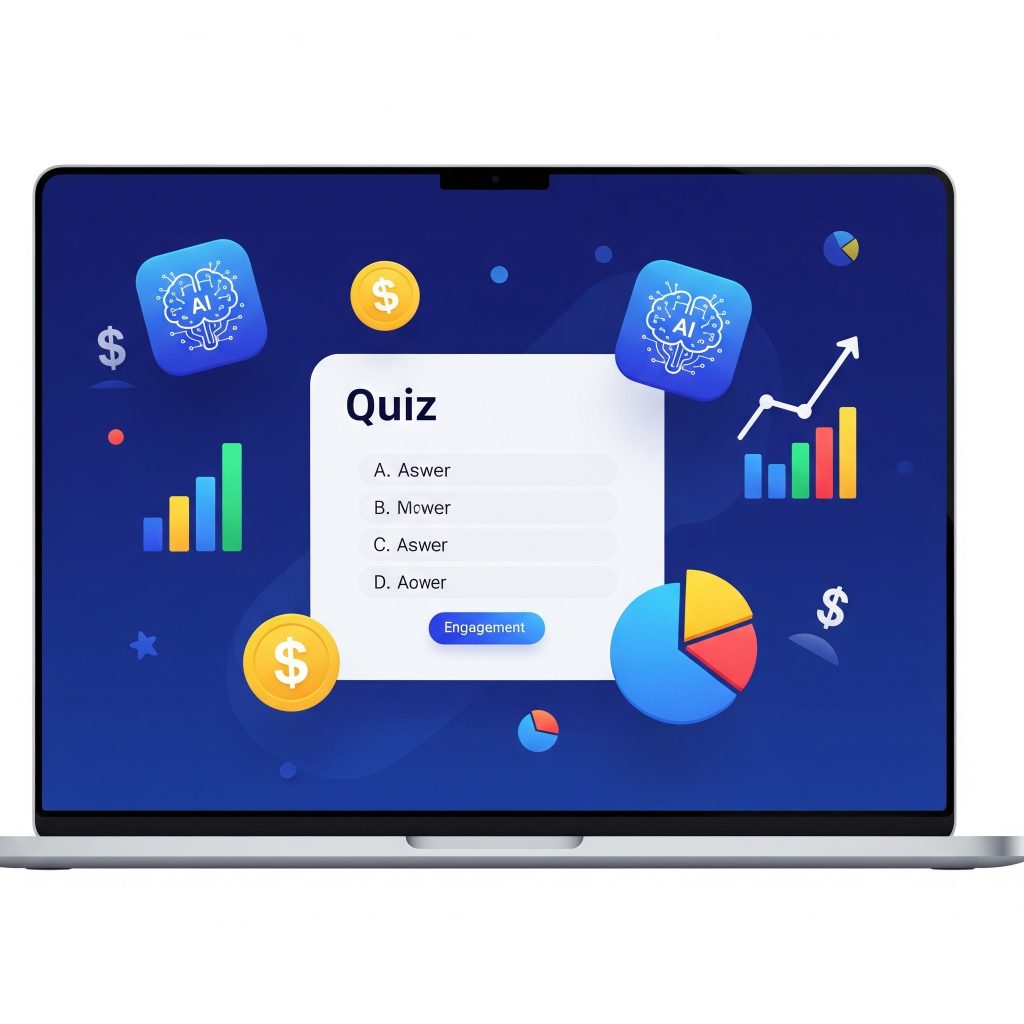
Learn how to use AI to create interactive quizzes that generate revenue. Monetize quizzes for blogs, social media, and businesses in 2025.
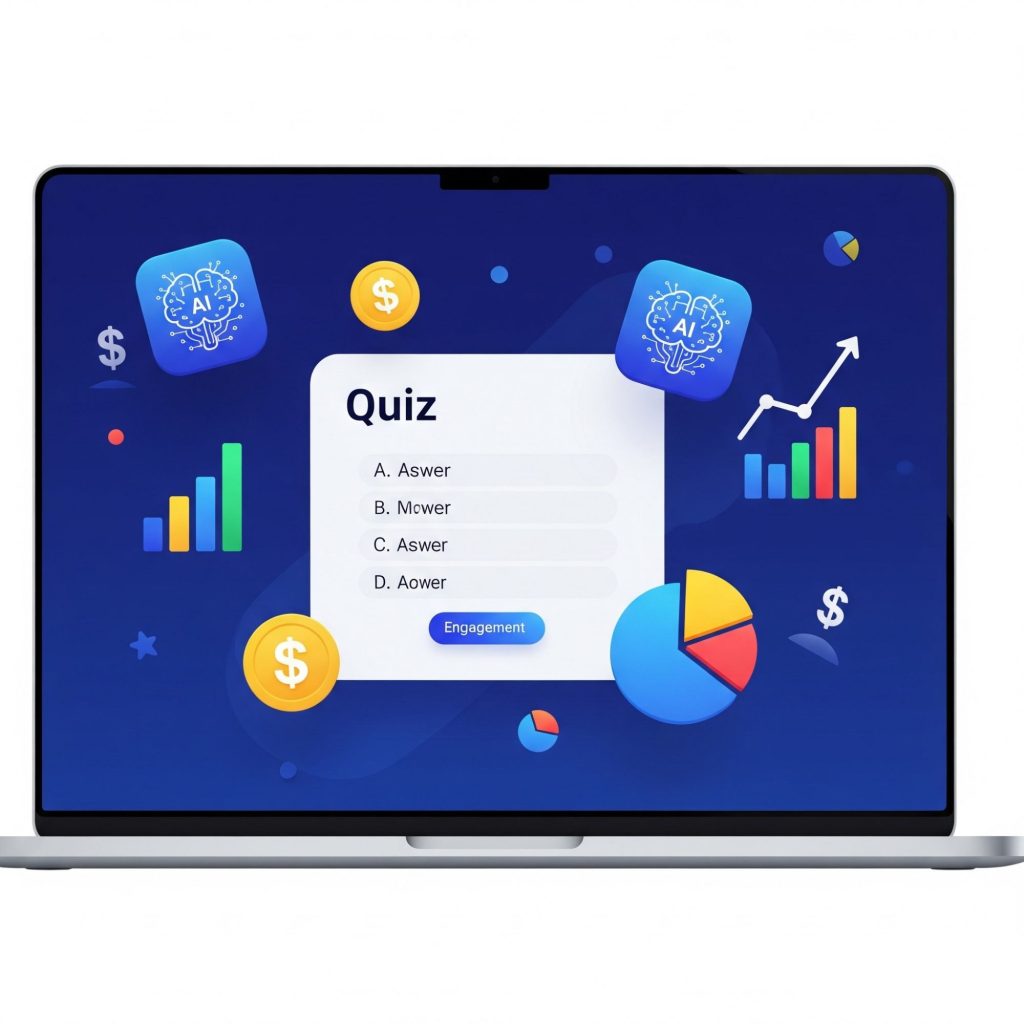
Using AI to Create Interactive Quizzes That Pay — Smart 2025 Strategy
Turn quizzes into revenue engines: lead capture, product recommendations, affiliate funnels, paid assessments, learning products and gamified subscriptions. This guide covers tools, workflows, monetization, pricing, SOPs, marketing, and a 90-day roadmap.
Why Quizzes + AI = Profit (short answer)
Interactive quizzes are attention magnets that convert casual visitors into engaged leads. AI accelerates quiz production by generating targeted questions, branching logic, personalized result copy, attendant visuals, and custom offers — all at scale. When combined with clever monetization funnels (affiliate, product recommendation, paid assessment), quizzes become consistent revenue drivers.
Quick benefit: a well-placed quiz can multiply conversion rates for email capture, double average order value with personalized recommendations, and create high-ticket outcomes (paid certification/assessment) with low incremental cost thanks to AI.
Profitable Business Models Using Quizzes
- Lead magnet → Email / Product Funnel: Free quiz captures email, then you nurture and sell a digital product or course.
- Affiliate recommendation engine: Quiz recommends products and links to affiliate offers — higher AOV when matched well.
- Paid assessment / certification: Charge for advanced assessment and a verified certificate (suitable for skills & hiring).
- SaaS / Widget licensing: Build a quiz-builder widget and license it to publishers or agencies.
- Agency/DFY quiz creation: Build & host quizzes for businesses as a service (recurring fees for hosting/analysis).
- Micro-consulting upsell: Quiz highlights gaps — sell a personalized consulting session or done-for-you fix.
- Advertised quizzes: Sponsored quizzes where brands pay to be the recommended outcome.
Start simple: free quiz lead magnet → affiliate/product funnel. As you gather data, add paid and white-label options for higher revenue.
Best Niches for Quick Monetization
- Career & Skills: “Which developer role suits you?” + paid resume review upsell or course recommendations.
- Finance & Investing: risk profile quizzes leading to affiliate brokerage offers or paid coaching.
- Marketing & Growth: “Score your content strategy” → upsell template packs or consultancy.
- Health & Wellness: personalized meal/fitness plans + affiliate supplements or paid plans.
- Education & Exams: placement tests leading to paid prep courses or certification.
- Ecommerce Product Finder: personalized product matches with affiliate links or store SKUs.
- Business Tools Fit-Finder: recommend SaaS stacks to SMEs — partner with vendors for referral fees.
Pick a niche with clear commercial intent—people looking to buy or invest in solutions convert best.
Top AI Tools & Comparison Table
Choose tools for question generation, branching logic, personalization copy, hosting and analytics. Below is a comparative table to get started.
| Tool | Primary Use | Strengths | Notes |
|---|---|---|---|
| Typeform / Outgrow / Interact | Interactive quiz hosting & logic | User-friendly, built-in lead capture & integrations | Good to launch fast; some limits on complex personalization |
| ChatGPT / Claude / Bard | Question generation, result copy, personalization text | Fast multi-variant copy & templates; tone control | Use for both Q/A and result copy; requires human QA |
| Make.com / Zapier | Automations & integrations (CRM, Email, Affiliate) | Connect quiz to email marketing & 3rd-party platforms | Essential to monetize funnels |
| OpenAI Embeddings / Pinecone | Personalization & recommendation matching | Powerful for product/result matching and fuzzy lookups | Requires some engineering but highly effective |
| Zapier / Webhooks + Custom Host | Webhook handling & dynamic result pages | Enables real-time personalized offers and tracking | Best for scaling and custom monetization |
| Analytics: GA4 / Mixpanel | Measure conversions, funnel steps & cohort data | Essential for optimization & A/B testing | Set up events early |
| Payment & Checkout (Gumroad, Stripe) | Paid assessment checkout | Quick setup for paid quizzes & certificate purchase | Use Stripe for custom flows, Gumroad for quick productization |
Starter combo: Typeform + ChatGPT (for content) + Zapier + Mailer (email) + Stripe/Gumroad for paid funnels. Add embeddings & custom logic as you scale.
End-to-End Workflow — Idea to Paying User (repeatable)
Below is a practical workflow you can implement today.
Step 1 — Product Idea & Outcome
Define the exact outcome the quiz delivers (e.g., “funding readiness score”, “3 best side hustles for you”, “interview readiness level”). Outcomes must be actionable.
Step 2 — Question Set & Branching
Use ChatGPT to craft a 7–12 question set. For higher personalization include conditional logic (e.g., if answer A then show question X). Design scoring or weighted logic to map answers to results.
Step 3 — Result Copy & Offers
Use AI to draft personalized result pages. Each result should include: core score, short analysis, 3 personalized recommendations (products/courses/services), CTA (email capture or paid upsell).
Step 4 — Build & Host
Implement quiz in Typeform/Interact or a custom host. Configure webhooks to send responses to your backend (or Zapier to your CRM/email) for follow-up flows and affiliate tracking.
Step 5 — Nurture & Monetize
After capture, run targeted email flows: free users receive a short sequence; high-intent users (score thresholds) receive product offers, affiliate links, or a paid assessment invite.
Step 6 — Track & Iterate
Track completion rates, conversion to email, conversion to purchase, and revenue per visitor. Use A/B testing on questions, hooks, result language and CTAs to optimize.
Design Principles for High-Converting Quizzes
- Keep it short: 7–12 questions is optimal for engagement. Use progress bars.
- Make it personal: use the user’s name and refer to previous answers in result copy when possible.
- Fast feedback loops: immediate, valuable result on completion; don’t force email before giving the core result (use partial gating wisely).
- Use weighted scoring: allow nuanced results and mid-tier outcomes to create upsell opportunities.
- Offer micro-wins: give one quick action the user can do within 24 hours — increases trust.
- Mobile-first: quizzes are often taken on mobile; keep buttons large and text concise.
- Visual cues: use icons, micro-animations and color to show progression and trust (badges, score meters).
Monetization Tactics & Funnel Examples
1) Affiliate Recommendation Funnel
- Free quiz → email capture → result page that recommends 2–3 products with affiliate links.
- Follow-up email sequence with in-depth reviews, promo codes and a limited-time bonus to increase clicks.
2) Paid Assessment + Certificate
- Free mini-quiz for initial score → invite to paid, pro-level assessment for ₹499–₹1,999 which includes detailed report and certificate.
- Offer employer-facing verification (extra fee) or bundled coaching call.
3) Product Upsell Funnel
- Quiz matches the exact product SKU or course module; use dynamic recommendations to show “best fit” and direct checkout or product page.
- Offer immediate discount on the product for quiz takers to increase conversion.
4) Sponsor & Branded Quizzes
- Build quizzes for brands and charge a flat fee + distribution bonus based on completion numbers or leads generated.
- Include brand messaging naturally in the result pages and emails.
5) Lead Gen for Agencies
- Offer clients custom quizzes to capture qualified leads. Charge setup + monthly hosting and analytics fee.
Key metric: revenue per quiz visitor. Aim to optimize that by testing offer, pricing and CTA placement. Micro-conversions (email → click → purchase) compound over time.
Pricing, Revenue Examples & Math
Examples in INR. Adjust to your market and niche.
Affiliate Funnel Example
Traffic: 1,000 visitors to quiz → 45% completion → 30% email capture (135 emails).
Affiliate conversion: 3% of emails click and buy (4 purchases) at average commission ₹1,200 → ₹4,800 revenue per 1,000 visitors.
Paid Assessment Example
Traffic: 1,000 visitors → 45% complete → 10% convert to paid assessment (45 sales) at ₹599 → ₹26,955 revenue per 1,000 visitors.
Revenue per visitor varies by niche and offer. Paid assessments dramatically increase revenue but require more upfront value and trust.
Pricing Options
- Free quiz with affiliate links: free product, revenue via affiliate conversions.
- Freemium + paid pro report: Basic free result; Premium report ₹299–₹999.
- Paid certification/assessment: ₹499–₹3,999 depending on niche and depth.
- White-label quiz setup: ₹10,000–₹75,000 per client + monthly hosting ₹2,499–₹9,999.
SOPs & Prompts — Copy-Paste Ready
SOP: Launch a Paid Assessment in 7 Days
- Day 1: Pick niche, outline outcomes, and define scoring logic (3 segments: beginner / intermediate / expert).
- Day 2: Generate 12 questions + weightings using LLM and sanity-check with a subject-matter expert (or quick research).
- Day 3: Create result copy templates (3 result types) via LLM; craft paid upsell report structure.
- Day 4: Build quiz in Typeform / Interact and connect webhook to Stripe/Gumroad for paid checkout.
- Day 5: Create email nurture flows (MailerLite / ConvertKit) — 5 emails: thanks, value add, case studies, discount, final CTA.
- Day 6: Test with 20 beta users, refine questions & copy, check payment flow and delivery of premium report (PDF generation via Zapier or Webhook).
- Day 7: Launch with small paid ads or outreach and monitor metrics.
Prompt: Generate Quiz Questions (ChatGPT)
You are an expert quiz designer. Create 10 multiple-choice questions for a quiz titled: "[QUIZ TITLE]". Each question should have 4 options and a short rationale (1 line) explaining what the answer reveals about the taker's profile. Also provide a scoring weight (1-5) for each option. Output as JSON with fields: question, options:[{text,weight}], rationale.
Prompt: Personalized Result Copy
Write a 120-200 word personalized result for a quiz taker who scored as "[RESULT NAME]". Include: headline, 3 insights about their profile, 2 practical next steps, and one product recommendation (short pitch). Use friendly, authoritative tone.
Webhook / Zapier Flow (high level)
Quiz completed → Zapier webhook receives payload → check score thresholds → if paid-offer-eligible then create Stripe checkout session and email link → if free then send personalized result + nurture sequence. Track events in GA4 and update CRM with tags.
Marketing Channels That Convert
- Organic social: short demo clips showing “what quiz results look like” and benefits (use reels/shorts/carousels).
- PPC ads: Facebook/Instagram/YouTube/TikTok ads to quiz landing page — cheap clicks and easy A/B of hooks.
- Partnerships: co-branded quizzes with niche newsletters or influencers (sponsor pays for distribution).
- SEO & content: blog posts targeting “which X are you” keywords and embedding the quiz in posts.
- Email: list activation and referral loops (share-with-friend incentives for extra content).
- Paid placements: pitch quizzes as content partnerships to publishers for traffic and lead quality.
Use viral share hooks (“Get your personalized plan”) and social proof (number of takers, average results) to increase CTRs and trust.
How to Scale — Automation, Templates & White-label
- Template library: create niche quiz templates (questions, copy, flows) you can spin up in minutes and sell as setup packages.
- Embeddable widget: build a small widget (SaaS) to let customers embed quizzes and collect leads — charge monthly.
- Affiliate partnerships: partner with product vendors and take referral fees on high-ticket conversions.
- Agency model: hire quiz copywriters & analysts and sell DFY with SLA-backed conversion guarantees.
- Analytics & personalization: implement embeddings/matching (Pinecone) to improve recommendations and increase conversion per user.
- Localization: translate quizzes and regionally optimize offers — opens new markets with low incremental cost.
Scale with data: your recommendation model improves as you collect real quiz-to-purchase mapping. Use those signals to increase revenue per visitor over time.
Recommended Daily Routine for a Quiz Creator (9–5 plan)
- 09:00–09:30 — Check analytics: completion rate, email capture rates, conversion to paid offers.
- 09:30–12:00 — Product work: create new quiz questions, refine result copy, or build new variant templates.
- 12:30–14:00 — Marketing: write social posts, set up ad experiments, reach out to partners.
- 14:00–15:30 — Operations: review webhooks, payment flows, and any support tickets.
- 15:30–17:00 — Growth tasks: A/B test pages, refine email funnels and work on embedding or white-label leads.
90-Day Roadmap — From Idea to Recurring Revenue
Days 1–7: MVP
- Choose niche and core outcome; build 1 high-value quiz (free + paid assessment option).
- Integrate with email provider and Stripe/Gumroad for paid flows.
- Run 20–50 beta users and collect qualitative feedback.
Days 8–30: Launch & Validate
- Launch with targeted organic outreach and small ad spend to validate conversion rates.
- Iterate on questions and result copy based on data; implement at least 3 A/B tests.
Days 31–60: Productize & Monetize
- Create paid assessment report and automate PDF generation and delivery.
- Build email funnels for free takers and paid upsell flow; aim for 2–5% paid conversion.
- Publish 1–2 template quizzes and offer DFY setup services.
Days 61–90: Scale & Partnerships
- Partner with 3 newsletters or micro-influencers to drive traffic; test co-branded quizzes.
- Start selling white-label setups to agencies; set up a basic SaaS/widget plan if demand exists.
- Refine analytics, implement recommendation improvements (embeddings), and double down on highest LTV channels.
By day 90 you should have at least one reliable paid funnel, a small library of templates, and one partnership channel delivering predictable traffic.
Legal, Accuracy & Best Practices
- Data privacy: follow local laws (e.g., GDPR) — state how you use emails and how long you retain quiz responses.
- Accuracy & claims: do not overclaim quiz outcomes (e.g., “This quiz guarantees you’ll get a job”). Use outcome language like “improves chance” or “recommended path”.
- Affiliate disclosure: disclose affiliate links on result pages and emails to comply with regulations and trust.
- Paid assessments: ensure the report provides real value and avoid misrepresentation; include refund & revision policy.
- IP & content: if you use client data or proprietary questions, define ownership and license terms clearly in contracts.
TrendVibz Internal Links (Cross-sell & Learn)
- AI Tools to Create Viral Social Media Posts for Profit — use viral post strategies to promote quizzes and drive organic traffic.
- Make Money with AI-Powered Infographics — create infographic results or report visuals as premium upsells for quiz takers.
- Create AI-Based Audio Content and Sell Online — repurpose quiz results into personalized audio reports or microcasts for paid users.
- How to Make Money with AI Podcast Scripts — convert quiz insights into tailored podcast episode ideas or scripts for content creators.
Final Checklist — Launch a Paying Quiz Today
- Pick a niche with clear commercial intent and define one measurable outcome.
- Build 10–12 validated questions with weighted scoring and AI-generated result copy.
- Host the quiz (Typeform/Interact or custom), connect webhooks to your CRM and payment system.
- Create a premium upsell (paid assessment, product recommendation, or consultancy) and test pricing.
- Run small ad tests and organic promos; measure revenue per visitor and optimize the funnel.
- Collect real user data to improve recommendations and product-match accuracy over time.
Closing tip: a quiz is a testing engine. Use it to learn what offers convert for your audience, then scale the winning funnels into products, subscriptions or B2B services.