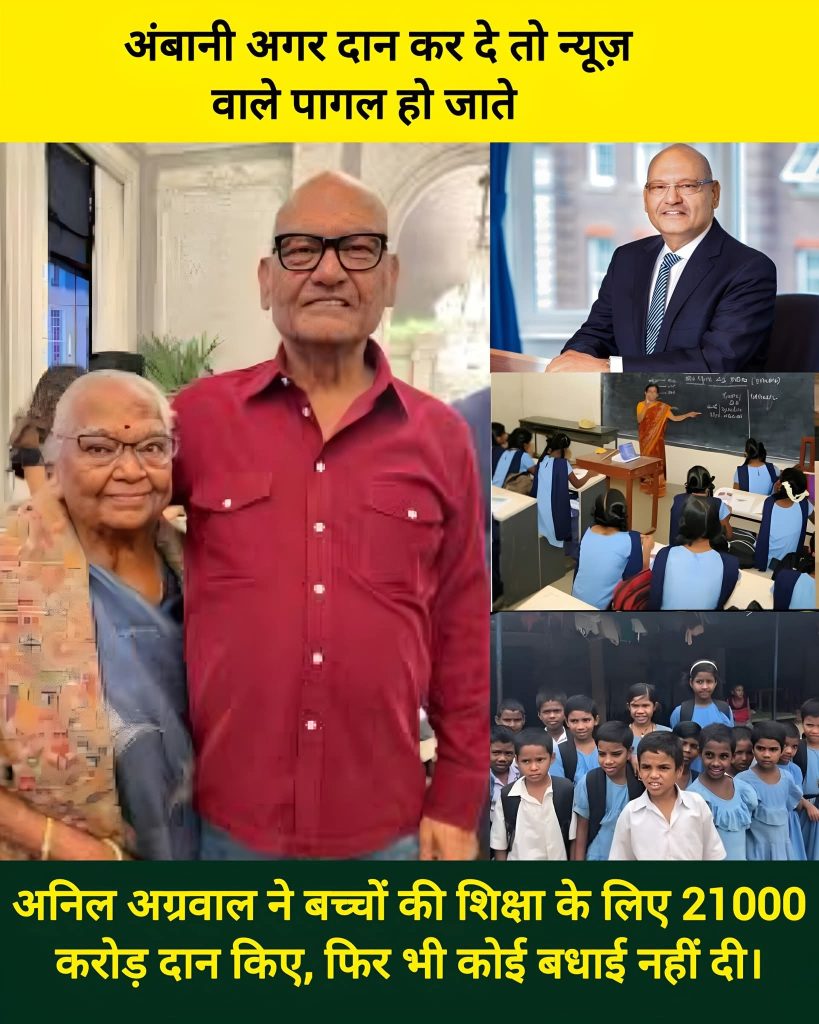
While Anil Agarwal donates ₹21,000 crore for children’s education, the media stays silent — proving real generosity often speaks quietly.
A Grand Promise Made
In September 2014, Anil Agarwal, chairman of Vedanta Resources, publicly announced that he would give away 75% of his wealth — about USD 3.5 billion (approx. ₹21,000 crore at the time) — to charitable causes, especially focusing on education and children’s welfare. Business Standard+1
His statement:
“My family supports my decision that 75 per cent of our wealth … should be returned to society.” Business Standard+1
The pledge generated some coverage. Indian media noted that Agarwal intended to create a world-class not-for-profit university, modelled on global standards, near Puri in Odisha. Business Standard+1
What The Numbers Say
- The amount quoted: ~₹21,000 crore (when converting his pledge of USD 3.5 billion) to Indian rupees at that time. AajTak+1
- His focus: free education in India, building a new university, funding early childcare centres (Nand Ghars) and under-privileged children. https://www.dinamalar.com+1
- His philanthropic arm: The Anil Agarwal Foundation and the Vedanta Foundation. Wikipedia
Despite the pledge’s scale, it appears there is limited sustained media follow-up about how much has been actually spent, where the funds are, or how the education end-goals are being achieved.
Why So Little Public Recognition?
There are several possible reasons for the relative silence:
- Ambiguity in Implementation
While the pledge is large, details of how it is being used (which institutions, timelines, scope) were sparse in the original announcement. Business Standard - Media Focus & Narratives
Big philanthropy by industrialists sometimes gets overshadowed by controversies, business news, politics. A pledge is one thing; execution and public outcomes are another. - Timing & Follow-Up
The announcement was made in 2014. Unless new milestones or public reports emerge, the story may fade from attention. - Perception of Business Philanthropy
Sometimes large philanthropic pledges by business leaders are scrutinized for tax/CSR implications, which may affect public narrative.
What’s Being Done on the Ground
- The Vedanta Foundation reports multiple “Nand Ghar” centres (modernised Anganwadis) across India for children’s education and early childcare. Vedanta Limited+1
- Agarwal has stated that his education vision includes establishing a not-for-profit university, akin to Stanford or Oxford, for India’s future generations. Hindu Janajagruti Samiti
These are promising signals — but widespread media-coverage and external audit reports seem limited.
The Importance of Recognition
When such large philanthropic commitments are made, public acknowledgement and transparency matter. Here’s why:
- Inspiration: Large acts of giving inspire others — that ripple effect is magnified when the story is told.
- Accountability: Public recognition helps ensure that pledges translate into action and don’t remain symbolic.
- Visibility for Beneficiaries: When education-initiatives are widely covered, the children and communities served receive recognition too.
A Broader Connection
It reminds us of other stories where large acts of kindness or service by individuals go under-reported.
👉 Related: The Coal-Covered Father Who Won the Internet’s Heart — A True Story of Love and Dedication 🖤👨👦
Both stories show that acts of real impact deserve more than headlines — they deserve sustained attention.
Final Thoughts
Anil Agarwal’s pledge to donate ₹21,000 crore toward children’s education is noteworthy. But for a nation where education remains a major challenge, it raises questions:
- How much has actually been spent so far?
- What measurable outcomes exist?
- Will the public receive regular updates on progress?
Perhaps the answer lies in turning large promises into visible change — classrooms built, teachers trained, children uplifted.
Because when a pledge of such scale is made, the real story isn’t the announcement — it’s the impact.