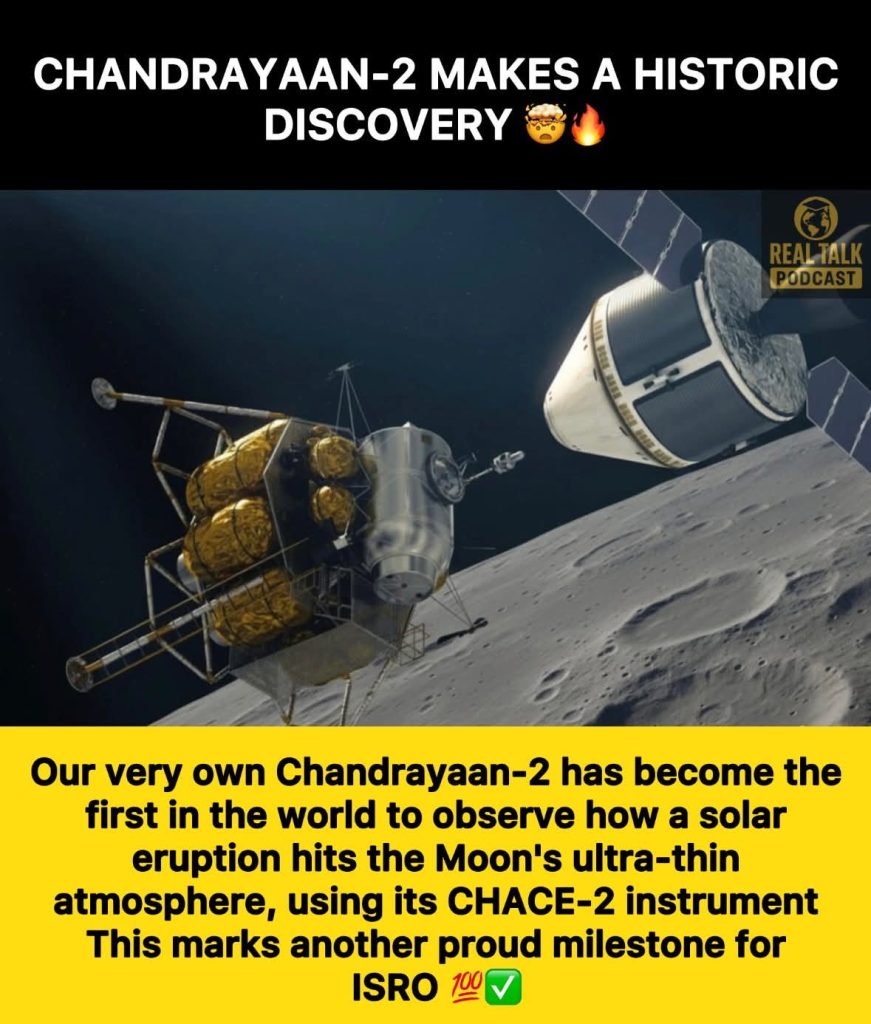
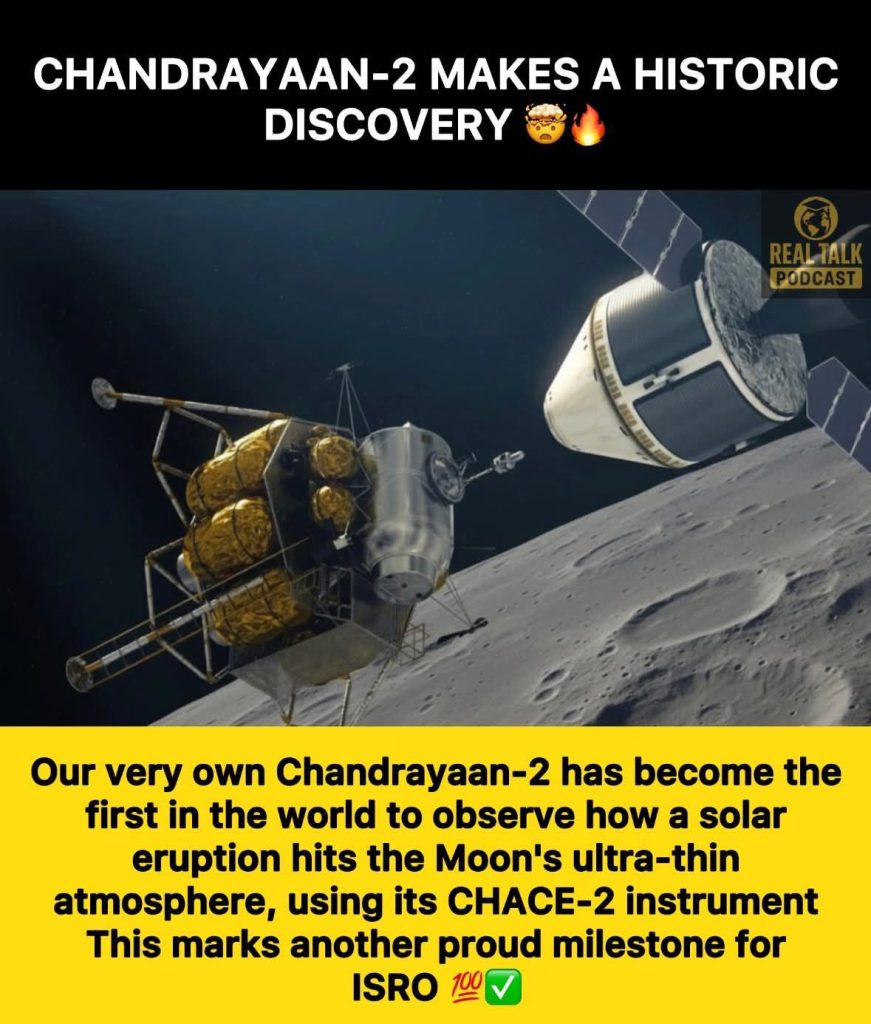
Chandrayaan-2 makes history as ISRO’s orbiter observes solar eruptions impacting the Moon’s atmosphere—a global first in space research.
A Mission That Kept Reaching Beyond Expectations
Launched on 22 July 2019 by the Indian Space Research Organisation (ISRO), Chandrayaan-2 carried Indian hopes aloft. Though its lander module did not make a perfect touchdown, the orbiter has been working tirelessly, conducting high-precision experiments and delivering science that is rewriting lunar lore. ISRO+2ISRO+2
What makes the latest findings special is that they come not from a landing site alone, but from below the surface and from the Moon’s ultra-thin atmosphere (the exosphere) — areas that were previously only partly understood.
The Unseen Discovery: Argon-40, Solar Impact & Lunar Water-Ice
Several major discoveries by Chandrayaan-2 are now gaining attention:
- The payload CHACE-2 on board detected the noble gas Argon-40 in significant amounts in the lunar exosphere, including at mid-latitudes. This suggests that the Moon’s surface and near-surface regions are more dynamic than previously known. India Today+1
- The orbiter observed for the first time the direct impact of a solar Coronal Mass Ejection (CME) on the lunar exosphere, showing how solar activity knocks atoms off the lunar surface and changes the exosphere’s density. The Economic Times+1
- Using its radar and imaging instruments, the mission detected water-ice in permanently shadowed craters near the Moon’s poles, reinforcing earlier indications and helping map where lunar resources may one day be used. India Today
Together, these discoveries position Chandrayaan-2 not just as a milestone for India, but as a serious contributor to global lunar science.
Why These Results Matter
These findings matter because:
- They show the Moon is not static. Even though it has no thick atmosphere, the interaction of solar winds, meteorite impacts and surface processes are actively shaping its exosphere and near-surface environment.
- For future lunar missions — whether human bases or resource-utilising outposts — knowing where water or ice exists, where atoms are liberated by the sun, and where the subsurface is rich with gases like Argon helps in planning habitats, mining, and sustainability.
- For India, the results mark a leap in scientific capability: indigenous instrumentation, deep space mission management, and data → analysis workflows that match global standards.
Chandrayaan-2’s Journey: From Launch to Science
- Launch & Orbit
The mission took off on 22 July 2019 from Satish Dhawan Space Centre, Sriharikota. The orbiter entered lunar orbit on 20 Aug 2019. ISRO+1 - Instruments at Work
The orbiter carries eight scientific payloads — among them, CLASS (X-ray spectrometer), CHACE-2, DFSAR (radar to probe subsurface), XSM (solar X-ray monitor) etc. ISRO+1 - Science Over Time
Over thousands of lunar orbits (~9,000+ by 2021) the instruments collected data on terrain, topography, composition, radiation interactions, and exosphere behaviour. The Economic Times+1 - Landers & Setbacks
While the lander “Vikram” lost communication during the descent, the orbiter remained fully functional and scientifically productive. Wikipedia - Recent Milestones
The detection of solar CME impact, advanced mapping of elements including Sodium and Argon, depth radar probing, and mapping of water-ice are all part of the mission’s growing legacy.
India’s Lunar Leap and Global Impact
India now joins a select group of nations whose missions have uncovered new science about the Moon. That elevates India’s space programme and opens updated collaboration, credibility, and future mission invitations.
It also sends a strong message: space exploration is not just about landing, it’s about understanding. In that sense, the silent orbiter continues to speak loudly.
Connection to Other Unsung Stories of Dedication
This mission’s story of striving silently, working under the radar and finally delivering for the world mirrors other human-interest narratives of dedication.
👉 Related: Anil Agarwal Donates ₹21,000 Crore for Children’s Education — Yet No Headlines?
Both stories ask: when the work is done, where is the recognition?
What Lies Ahead? Chandrayaan-3 and Beyond
Chandrayaan-3’s successful landing near the lunar south pole in 2023 sets the next chapter; but Chandrayaan-2’s data will support all future missions. The insights on water-ice, exosphere and subsurface composition will help design landing zones, mining strategies, lunar habitats, and even human survival infrastructure.
In short: the science from Chandrayaan-2 will be the foundation for India’s lunar ambitions for decades.
Challenges, But Not Barriers
Of course, there are challenges: data interpretation takes time, peer review is ongoing, funding and infrastructure must follow, and public awareness needs to catch up. But missions like this show that with vision, persistence, and talent — even complex objectives in space are possible.
Conclusion: A New Moon-Moment for India
Chandrayaan-2’s unseen lunar discoveries aren’t just scientific bullet-points — they are Indian triumphs of perseverance, vision and global leadership in space.
They remind us that progress is often quiet, away from the big headlines, but deeply transformative.
There on the Moon — beneath its dust and silence — India has planted its ambitions and started to unearth secrets that mankind has sought for millennia.